
Executive Summary
India’s upstream oil and gas sector is entering an ambitious expansion cycle. The Oil and Natural Gas Corporation (ONGC) has committed Rs 1 lakh crore (approximately $10.5 billion) to deepwater exploration over the next five years, targeting 87 wells drilled by FY2031 [1]. In parallel, ONGC and Oil India have announced a Rs 3,200 crore ($384 million) offshore drilling campaign with technical support from BP, adding to a pipeline of onshore and shallow-water activity across the Rajasthan, KG Basin, and Mumbai High assets [2]. As India accelerates its bid for greater energy self-sufficiency, the quality and specification-correctness of wellhead equipment at every casing string becomes a direct determinant of well integrity and long-term production performance.
Casing head housings and casing head spools are the foundational components of every wellhead assembly. They are the structural backbone onto which all subsequent wellhead equipment stacks: from the tubing head above to the casing string below. A specification mismatch, an incorrect pressure rating, or a material-grade shortfall at this level creates a failure point that propagates through the entire wellhead string. For Indian operators running multi-string programmes across varied geological formations, deepwater blocks in the Bay of Bengal, Rajasthan tight-oil plays, and sour-gas fields in Gujarat, getting this selection right is non-negotiable.
Parveen Industries, an API-Compliant wellhead and pressure control equipment manufacturer based in India, produces casing head spools and wellhead assemblies designed to the full requirements of API Specification 6A (21st Edition). With three decades of manufacturing and supply experience serving Indian and international operators, Parveen supplies wellhead equipment to onshore drilling programmes across India and offshore projects from facilities in Mumbai.
This article covers the engineering basis of API 6A casing head equipment, the differences between casing head housings and casing head spools, material and pressure class selection for Indian field conditions, and the specific product options available from Parveen Industries for procurement teams and drilling engineers specifying wellhead packages.
Understanding API 6A Casing Head Equipment: Components and Classification
API Specification 6A governs the design, manufacture, and testing of wellhead and Christmas tree equipment [3]. Under this standard, casing head equipment falls into the broader category of wellhead equipment and is subject to pressure class, temperature class, material class, and product specification level (PSL) requirements that together define a component’s fitness for a given well.
A complete casing head system consists of three primary elements: the casing head housing, the casing hanger, and the casing head spool. Each serves a distinct function.
Casing Head Housing
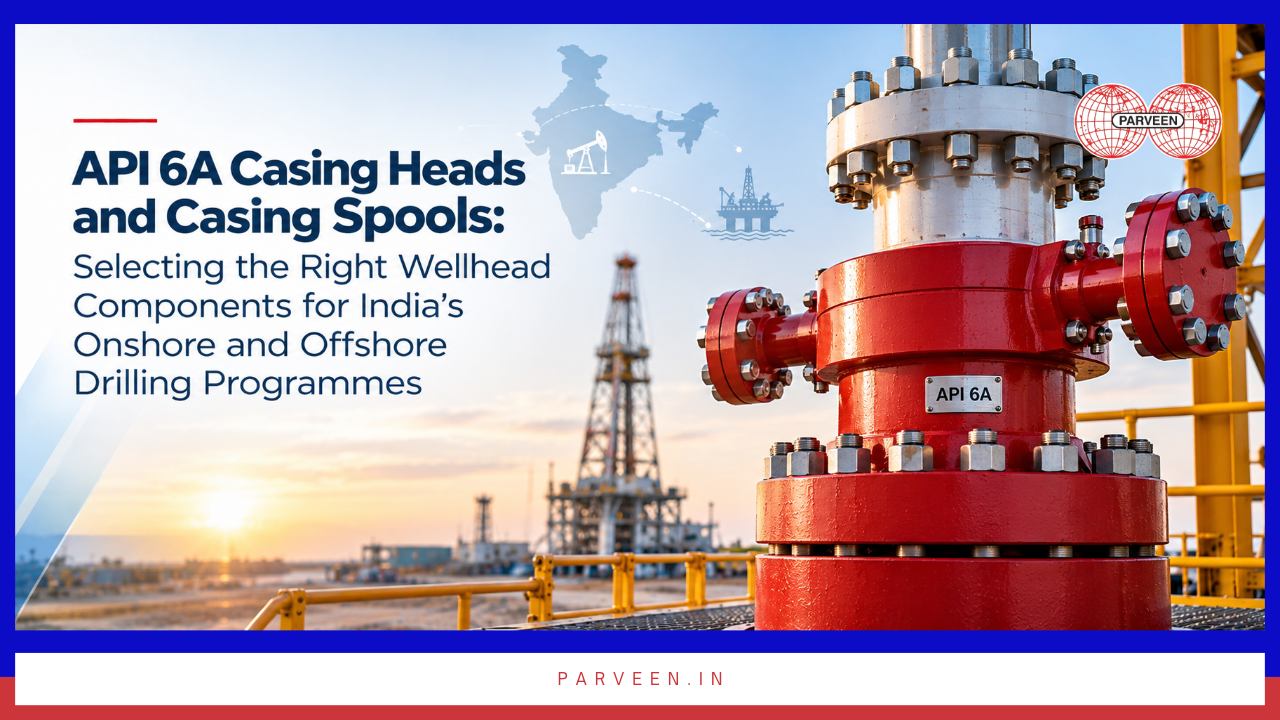
The casing head housing is the base component of the wellhead. It is threaded or welded directly to the top of the surface casing string and serves as the foundation onto which all subsequent wellhead equipment is mounted. The housing incorporates an internal bowl, a precisely machined tapered seat, into which the first casing hanger is landed. It also includes one or more side outlets, typically fitted with gate valves, that provide annular access for well control, pressure monitoring, and cementing operations.
API 6A defines casing head housing designs in terms of end connection type (flanged or studded top connection), bowl bore diameter to suit the casing OD and hanger, and working pressure class. The standard recognises 2,000, 3,000, 5,000, 10,000, 15,000, and 20,000 psi ratings. For India’s onshore programmes where formation pressures are more moderate, typical of the Rajasthan Basin and portions of the Cambay Basin, 3,000 psi or 5,000 psi housings are common. ONGC’s deepwater blocks in KG-DWN and GS-OSN, where hydrostatic pressures compound reservoir pressures, increasingly specify 10,000 psi equipment.
Casing Hangers
The casing hanger is the mechanical device that suspends the casing string inside the casing head housing or spool bowl. Slip-type hangers use segmented slips to grip the casing body and transfer string weight to the housing. Mandrel-type hangers thread directly onto the casing and land into a matching profile in the bowl. Regardless of type, the hanger must seal the annular space between the casing string and the housing interior, an isolation that prevents pressure migration between annuli and maintains well integrity throughout the well’s producing life.
API 6A specifies that casing hangers must be pressure-tested in both the downward (string weight) and upward (casing pressure) loading directions. For Indian formations with anomalous pore pressures, particularly sour-gas zones in the Jamnagar area of Gujarat, PSL 3 or PSL 4 hangers with enhanced metallurgical and test requirements are appropriate.
Casing Head Spools
The casing head spool is an intermediate wellhead body that stacks above the casing head housing and houses the next-string casing hanger. Where a well is drilled with multiple casing strings, conductor, surface, intermediate, and production, a separate spool is required for each intermediate casing string’s hanger. Each spool has a bottom flange that connects to the housing (or the previous spool) below and a top flange on which the tubing head or the next spool stacks above. Like the housing, each spool incorporates one or more side outlets with gate valves for annular access.
The selection of a spool is governed by the size transition it must accommodate: the bottom flange must suit the OD of the casing string it handles, while the top flange must suit the next-smaller casing string above. API 6A casing head spools are manufactured with matched flanges to API ring-groove standards, using BX or RX ring gaskets that are pressure-energised on make-up for a reliable, repeatable seal.
Casing Head Housings vs. Casing Head Spools: Engineering Differences and Selection Criteria
The practical distinction between a casing head housing and a casing head spool is less about their geometry, since both are bowl-type wellhead bodies with flanged ends and side outlets, and more about their position in the wellhead stack and the structural function each performs.
The casing head housing is a primary load-bearing element. It carries the full accumulated weight of the wellhead stack above it plus the weight of the suspended surface casing string below. Its base thread or weld to the casing must be executed with the casing running programme in mind: thread-on housings are common for smaller onshore programmes where quick rig-up speed matters, while weld-on housings are preferred for deepwater applications where connection reliability under sustained loading is paramount.
Casing head spools are intermediate elements in the stack. They transmit load axially between the components above and below and must be rated for the same working pressure as the housing, since the tubing head and tree above may subject the spool to full shut-in wellhead pressure. Spools are sized by their casing bowl bore on the lower end and their tubing bowl or companion flange bore on the upper end, a size reduction that reflects each successive casing string using a smaller OD as the well is drilled deeper.
For procurement engineers specifying a wellhead package for an Indian well, three decisions drive casing head selection:
Working pressure class: Surface and intermediate casing strings are run before the reservoir is penetrated. The working pressure class must account for the anticipated maximum annular shut-in pressure (MASICP) on each casing annulus. For exploratory wells in unproven deepwater blocks, a conservative pressure class with a safety margin is standard practice.
Bore sizes and outlet configuration: The housing bowl bore must accommodate the selected casing hanger OD. Outlet sizes determine the gate valve size for annular access, typically 2-1/16 inch or 2-9/16 inch outlets for onshore programmes, with larger outlets for offshore wells requiring greater flow capacity through the annular path.
PSL and material class: API 6A’s four product specification levels (PSL 1 through PSL 4) define increasing requirements for materials testing, dimensional inspection, and documentation. For standard onshore drilling in non-sour formations, PSL 1 or PSL 2 is adequate. Deepwater and sour-service wells require PSL 3 or PSL 4, with the higher level demanding full qualification testing including hydrostatically tested prototypes and third-party inspection.
Material Selection, PSL Requirements, and Sour Service for Indian Field Conditions
India’s producing formations span a wide range of fluid compositions. The Rajasthan Basin fields (operated by Cairn/Vedanta and ONGC) are predominantly oil-bearing with moderate GORs and limited H2S. The Jamnagar area of Gujarat and certain Vindhyan Basin formations produce sour gas with H2S partial pressures that require NACE MR0175 / ISO 15156-compliant materials across all wellhead wetted components. ONGC’s KG Basin deepwater blocks have produced sour gas condensate discoveries where the interaction of high pressure, elevated CO2, and H2S imposes significant corrosion and stress-corrosion cracking risk on wellhead bodies.
API 6A addresses material requirements through its Material Class system (AA through FF) and through PSL-driven charpy impact requirements and hardness limits aligned with sour-service standards. For casing heads and spools installed in sour-service wells, Material Class FF in combination with PSL 3 or PSL 4 provides the appropriate specification framework. Hardness of body material and weld heat-affected zones must stay below the NACE-specified HRC 22 limit to prevent sulphide stress cracking under H2S exposure.
For non-sour wells in India’s onshore basins, Assam-Arakan, Cambay, and KG onshore, Material Classes AA through DD cover the temperature range from moderate to elevated-temperature service. The API temperature classification system assigns letter codes to defined ranges: Class L covers temperatures down to -50°F, while Class V covers up to 350°F, relevant for some high-temperature reservoirs in Rajasthan where bottomhole temperatures can exceed 150°C.
Qualification and documentation requirements intensify with PSL level. PSL 4 components, the highest level, require destructive testing of body material coupons, body and bonnet castings or forgings to full mechanical property specifications, full hydrostatic testing of each production item, and third-party independent inspection. For large ONGC deepwater wellhead packages, PSL 4 procurement is increasingly specified. Indian procurement teams sourcing from domestic manufacturers should verify that equipment suppliers maintain an ISO 9001-certified quality management system aligned with API Spec Q1, and that mill traceability and test certification documentation is available for each component.
Parveen Industries’ Casing Head and Wellhead Equipment for India’s Drilling Programmes
Parveen Industries manufactures and supplies a range of API-Compliant wellhead components for Indian onshore and offshore applications, including casing head spools, wellhead assemblies, and ancillary wellhead gate valves. The company’s product range is designed to API Specification 6A (21st Edition) and addresses the full range of pressure classes and bore configurations required for multi-string casing programmes across India’s producing basins.
Casing Head Spool: Parveen’s casing head spool is a flanged wellhead body designed for stacking in multi-string casing programmes. It is manufactured with matched top and bottom API flanges in BX ring-groove profiles, integral side outlet ports for annular access, and customer-specified bowl bore diameters to accommodate casing OD and hanger designs. The spool is available in pressure classes from 2,000 psi through 10,000 psi working pressure, with material class and PSL options to suit standard and sour-service formations. All components are hydrostatically tested per API 6A requirements before shipment.
Single and Dual Completion Wellhead and Christmas Tree Assemblies: For procurement teams specifying a complete wellhead package rather than individual components, Parveen supplies integrated wellhead assemblies covering the full stack from the casing head to the Christmas tree. These assemblies include casing head, intermediate spools, tubing head spool, tubing hanger, and tree body, all matched to customer-specified casing sizes, pressure ratings, and bore configurations. Single and dual completion configurations are available for standard and sidetrack well programmes.
Unitized Wellhead (Manifold / Well Control Head): Parveen’s unitized wellhead design integrates the functions of the casing head housing and intermediate spools into a single compact body, reducing the number of flange connections in the wellhead stack and offering faster rig-up for high-volume onshore drilling programmes. This design is particularly suited to India’s onshore fields where rig mobilisation speed and pad drilling efficiency are key factors. The unitized configuration also reduces potential leak paths compared to a multi-piece stacked assembly.
Slab Gate Valves for Wellhead Annular Service: Casing head housings and spools require gate valves on each side outlet for annular access and well control. Parveen supplies API 6A-designed slab gate valves sized for 2-1/16 inch and 2-9/16 inch wellhead outlet flanges, in pressure classes to 10,000 psi. These valves are suitable for the annular access requirements of multi-string wellhead assemblies throughout the well’s drilling and production life.
Surface Safety Valve: Where wellhead safety isolation is required at surface, including deepwater operations on platforms where emergency shut-in capability is a regulatory requirement, Parveen’s surface safety valve provides a hydraulically actuated, fail-safe closed valve designed to API 6A and API 6AV1 requirements.
The full Parveen wellhead and pressure control product range for Indian applications is available at the wellhead and Christmas tree product category and all products page.
Case Illustration: Multi-String Wellhead Package for a KG Basin Deepwater Exploration Well
Consider an operator preparing a deepwater exploration well in the KG-DWN block in the Bay of Bengal, targeting a reservoir at approximately 4,200 metres below seabed, in a water depth of around 1,100 metres. Formation evaluation from offset wells indicates a gas condensate reservoir with anticipated shut-in wellhead pressure of 8,000 psi and confirmed H2S partial pressure placing the well in sour-service territory under NACE criteria.
The well design calls for a four-string casing programme: a 36-inch conductor, a 20-inch surface casing, a 13-5/8-inch intermediate casing, and a 9-5/8-inch production casing. The wellhead stack must accommodate three hanger landings before the tubing head is set for the production phase.
The procurement specification for this well requires a 10,000 psi working pressure wellhead system, Material Class FF, PSL 3, and full NACE MR0175 compliance across all wetted bodies. The casing head housing is a weld-on design threaded to the 20-inch surface casing, with a 13-5/8-inch nominal bowl bore to land the surface casing hanger. Above the housing, a casing head spool bridges from 13-5/8-inch on the lower flange to 9-5/8-inch at the upper flange to land the intermediate casing hanger. Each component is flanged with BX ring-groove connections pressure-rated to the 10,000 psi working class.
The procurement team sources the casing head housing and intermediate casing spool from Parveen Industries as part of a complete wellhead package that also includes side-outlet gate valves, the tubing head spool, and the Christmas tree assembly. The integrated package approach ensures dimensional compatibility across all flange faces and ring grooves, simplifying the rig-up sequence and reducing the risk of specification mismatch between components sourced from multiple suppliers.
Hydrostatic test certificates for each component, traceable material test reports, and API 6A conformance documentation are provided at time of shipment, meeting ONGC’s vendor qualification and third-party inspection requirements for deepwater wellhead packages.
Frequently Asked Questions
Q1: What is the difference between a casing head housing and a casing head spool under API 6A?
Under API Specification 6A, both a casing head housing and a casing head spool are wellhead bodies designed to support and seal a casing string. The casing head housing is the primary base component that is welded or threaded directly to the top of the surface casing. It incorporates the first casing hanger bowl and has side outlets with gate valves for annular access. The casing head spool is an intermediate body that stacks above the housing to provide a separate hanger bowl for the next-smaller casing string. It has a bottom flange connecting to the housing (or the previous spool) and a top flange that accepts the next component in the stack. A well with multiple casing strings requires one housing and one spool for each intermediate casing string below the tubing head.
Q2: Which API 6A pressure class is correct for a wellhead casing head in India’s onshore drilling programmes?
The pressure class selection depends on the anticipated maximum annular shut-in pressure (MASICP) for the specific casing string the housing or spool will support. For shallow, low-pressure onshore wells in the Cambay or Assam basins, 2,000 psi or 3,000 psi working pressure is often sufficient. For higher-pressure onshore plays in Rajasthan or the Vindhyan Basin, 5,000 psi is common. ONGC’s offshore and deepwater programmes typically specify 10,000 psi. API Specification 6A recommends that the rated working pressure of the wellhead component equal or exceed the MASICP for the annulus it seals, with an appropriate safety margin for exploratory wells where reservoir pressure is not fully defined.
Q3: What PSL level is required for ONGC deepwater wellhead packages?
ONGC’s deepwater drilling programme specifications for wellhead equipment typically require PSL 3 as a minimum, with PSL 4 often specified for critical wellhead bodies on high-pressure and sour-service wells. PSL 3 mandates charpy impact testing at the minimum design temperature, full hardness testing across body, closure, and stems, and documentation traceability to raw material certifications. PSL 4 adds prototype qualification testing for each valve size and class and requires third-party inspection by an ONGC or customer-approved inspection authority at the manufacturer’s facility. Procurement teams should confirm PSL requirements explicitly in the purchase specification rather than relying on a supplier’s general API 6A compliance claim.
Q4: Can Parveen Industries supply a casing head spool for sour-service (H2S) applications in India?
Yes. Parveen Industries manufactures casing head spools to Material Class FF for sour-service applications, in compliance with NACE MR0175 / ISO 15156. This includes body material with controlled hardness below HRC 22, fully NACE-qualified seal materials, and test documentation confirming H2S compatibility. For procurement teams specifying sour-service wellhead equipment in India’s Gujarat or KG Basin sour-gas fields, Parveen’s sour-service casing components can be ordered with the appropriate material class and PSL designation as part of a complete wellhead package.
Q5: How is a casing head housing connected to the surface casing on Indian drilling rigs?
Casing head housings are connected to surface casing by one of two methods: threaded connections or weld-on connections. Threaded housings are screwed onto a prepared thread cut on the top of the surface casing joint before it is run. This method is faster and does not require a welder on location, making it common for high-volume onshore drilling programmes on Indian land rigs. Weld-on housings are slip-on bodies that are welded to the casing OD after the surface casing is set and cemented. The weld-on method produces a structurally superior connection and is preferred for offshore and deepwater wells where the housing must sustain higher axial loads. API 6A defines requirements for both connection types, including minimum thread engagement and weld qualification standards.
Q6: Can Parveen supply a complete wellhead stack as an integrated package for Indian operators?
Yes. Parveen Industries supplies complete integrated wellhead packages covering the full stack from the casing head housing through the Christmas tree assembly, configured to customer-specified casing sizes, pressure ratings, and bore configurations. Package supply eliminates dimensional compatibility risk between components sourced from different manufacturers and simplifies the inspection and documentation process for ONGC and other Indian operators with multi-party vendor qualification requirements. Single and dual completion configurations are available. Enquiries for complete wellhead packages should be directed to Parveen Industries directly for a configuration review against the specific well programme.
Specify API 6A Casing Head Equipment for Your Indian Drilling Programme
India’s upstream acceleration, from ONGC’s Bay of Bengal deepwater blocks to onshore pad drilling campaigns in Rajasthan and Assam, places sustained demand on API 6A wellhead equipment manufactured to consistent, verifiable specifications. Casing head housings and spools are the foundation of every wellhead stack. Specifying the correct pressure class, PSL level, and material class for each string’s hanger location, and sourcing those components from a manufacturer whose quality management system is independently audited, is the foundation of well integrity from spud to abandonment.
Parveen Industries is an API-Compliant manufacturer of casing head spools, wellhead assemblies, gate valves, and pressure control equipment based in India, with direct supply capability to drilling programmes across the country’s onshore and offshore basins.
Email: info@parveen.in Website: https://parveen.in/
Explore the full wellhead product range at https://parveen.in/products/.
Data Sources & References
[1] ONGC Plans Rs 1 Lakh Crore Deepwater Push, Targets 87 Wells by FY31. Business Today, September 2026. https://www.businesstoday.in/latest/corporate/story/ongc-plans-rs-1-lakh-crore-deepwater-push-targets-87-wells-by-fy31-552480-2026-09-01
[2] ONGC and Oil India Launch Rs 3,200 Crore Offshore Drilling Campaign with BP Technical Support. Black Ridge Research, 2026. https://www.blackridgeresearch.com/news-releases/ongc-oil-india-launch-3200-crore-offshore-drilling-campaign
[3] API Specification 6A, Specification for Wellhead and Tree Equipment, 21st Edition. American Petroleum Institute. https://www.api.org/products-and-services/standards/important-standards-and-initiatives/standards-6a
[4] India’s ONGC Plans $10.5bn Offshore Drilling Drive, Eyes 87 Wells by 2031. Baird Maritime, 2026. https://www.bairdmaritime.com/offshore/exploration-development/indias-ongc-plans-10b-offshore-drilling-drive-eyes-87-wells-by-2031
[5] ONGC Plans $20 Billion Deepwater Expansion to Boost Domestic Energy Output. Angel One, 2026. https://www.angelone.in/news/stocks/ongc-plans-20-billion-deepwater-expansion-to-boost-domestic-energy-output
