
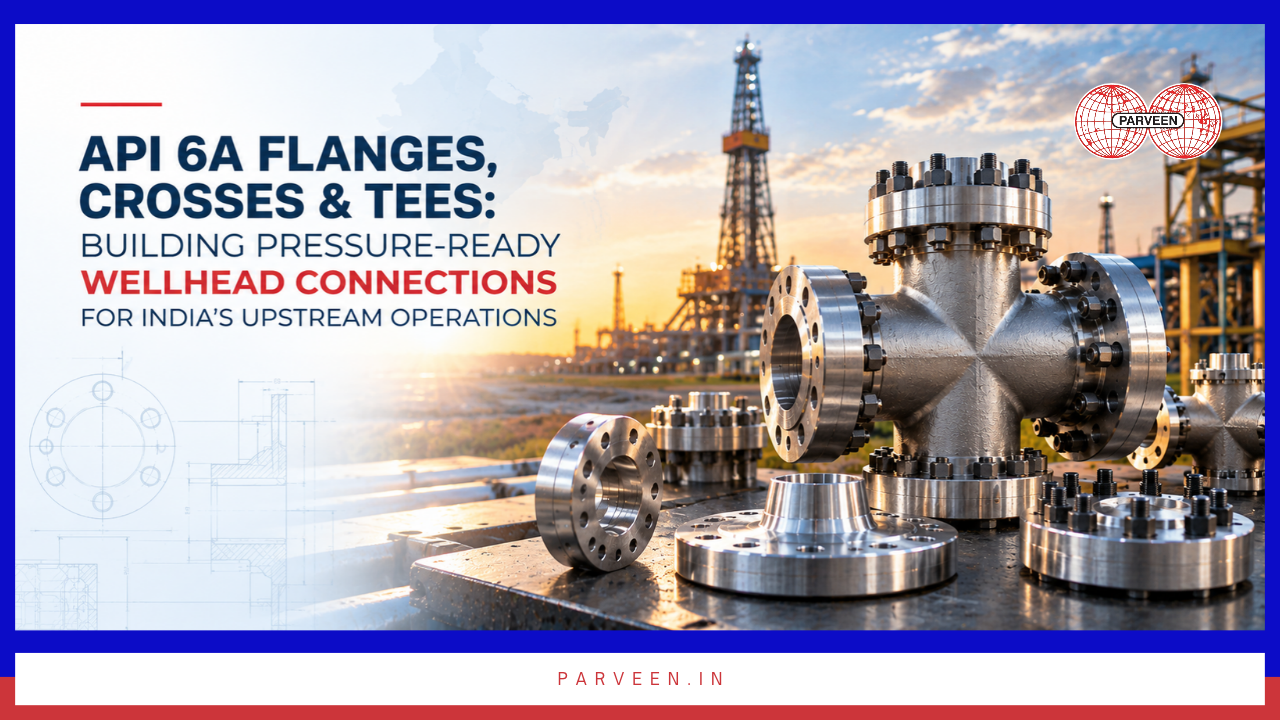
India’s upstream oil and gas sector is undergoing a structural expansion. The Ministry of Petroleum and Natural Gas has progressively opened exploration acreage under successive rounds of the Open Acreage Licensing Programme (OALP), with cumulative bidding rounds awarding exploration blocks across the Krishna-Godavari, Mahanadi, Vindhyan, and Cambay basins [1]. ONGC, India’s largest national oil company, has committed to sustaining capital expenditure at approximately ₹33,000 crore annually through its ongoing development programs to arrest production decline in ageing fields while adding incremental reserves from new wells [2]. Alongside ONGC, Oil India Limited (OIL) and private operators such as Vedanta are accelerating well programs across Rajasthan, Assam, and the Andamans.
Within this context, wellhead integrity has emerged as a non-negotiable priority. Every wellhead assembly integrates a series of pressure-boundary connection elements, flanges, crosses, and tees, that create the structural and hydraulic interface between downhole tubing strings, casing hangers, gate valves, choke manifolds, and flow control equipment. These components are specified under API 6A (21st Edition), which governs dimensional requirements, pressure ratings, material selection, and performance testing protocols for wellhead and Christmas tree equipment [3]. For Indian operators, where well designs must accommodate both sweet gas and H₂S-bearing formations, choosing the right flange type, pressure class, and face geometry is essential to preventing fugitive emissions, flange leaks, and catastrophic pressure loss events.
Parveen Industries has manufactured API 6A compliant wellhead connection components, including 6B and 6BX flanges, integral flanges, blind and test flanges, adapter and companion flanges, studded crosses & tees, and flanged crosses & tees, since 1983. With eight manufacturing facilities across Delhi, Haryana, and Mumbai, Parveen delivers these components to ONGC, OIL, Vedanta, and domestic EPC contractors as part of complete wellhead assemblies and as standalone supply against documented dimensional and material specifications. This article examines the engineering considerations governing flange and cross/tee selection for India’s upstream operating environment, and explains how each product in Parveen’s connection component portfolio supports pressure-ready wellhead construction.
India’s upstream sector presents a particularly demanding design environment. Many of Parveen’s domestic clients operate wells in the Rajasthan basin (where Vedanta’s Barmer operations encounter H₂S and high wellhead pressures), the Mumbai High offshore (where ONGC’s aging infrastructure undergoes incremental wellhead rehabilitation), and the Cambay basin (where gas production requires tight sealing at moderate pressures). The correct specification of API 6A flanges and connection fittings, matched to the prevailing pressure class, temperature rating, and fluid service, is the first line of defence against wellhead integrity failures that can result in unplanned shutdowns, environmental incidents, and production loss.
Understanding API 6A Connection Components: Flanges, Crosses & Tees
What API 6A Governs
API Specification 6A is the governing standard for wellheads and Christmas tree equipment used in the oil and gas industry. Its 21st Edition covers all flanged, studded, and threaded end connections used to assemble wellhead components, defining rated working pressures from 2,000 psi to 20,000 psi across temperature classes AA through HH, and material classes AA through HH for various fluid services [3]. Under API 6A, every flange used in a wellhead assembly must conform to one of two flange types, 6B (Ring Joint Facing) or 6BX (Pressure-Energised), depending on the working pressure and application.
For Indian operators, the relevance of API 6A extends beyond generic compliance. The API Monogram Program, under which Parveen operates, requires that manufacturers demonstrate the capability to consistently produce components to specification through documented quality management, design validation, and traceability of materials from mill certificate to finished part. This level of documented compliance is increasingly required by ONGC in its equipment procurement tenders and by international joint venture partners operating in Indian blocks.
6B Flanges: Standard Ring Joint Connections
6B flanges are the workhorse of wellhead connection assemblies in the moderate-pressure range. Designed with octagonal or oval ring-joint grooves (RTJ facing), 6B flanges create a metal-to-metal seal via a soft iron or low-alloy steel ring gasket compressed between the mating faces. API 6A specifies 6B flanges for rated working pressures up to 10,000 psi, making them suitable for the majority of India’s onshore production wellheads, particularly in fields such as Mehsana (Cambay basin) and Upper Assam, where wellhead pressures typically range between 1,500 and 5,000 psi [4].
The dimensional standard for 6B flanges, bolt circle diameter, raised face bore, number and size of bolts, groove geometry, is exhaustively prescribed by API 6A Table 1 and associated dimensional tables. This standardisation ensures that Parveen-manufactured 6B flanges are dimensionally interchangeable with wellhead components from any other API 6A Monogram-compliant manufacturer, which is critical in field replacement scenarios or when integrating into multi-vendor wellhead assemblies.
Parveen manufactures 6B flanges in a range of bore sizes and pressure classes, in materials conforming to AISI 4130 alloy steel (AA material class for sweet service), 316 stainless steel (DD class for moderate sour service), and Inconel 625 / duplex stainless (EE/FF classes for high-H₂S environments). Material selection aligns with NACE MR0175 / ISO 15156 requirements, which are increasingly relevant for operators encountering H₂S in India’s Rajasthan and KG basin formations.
6BX Flanges: Pressure-Energised Connections for HPHT Applications
For wellhead assemblies operating at working pressures above 10,000 psi, including HPHT wells in the KG-DWN block series and deepwater ONGC locations, API 6A mandates 6BX flanges. The 6BX design features a pressure-energised ring-joint groove with a BX-profile ring gasket. As wellhead pressure increases, the BX ring is further energised, enhancing seal tightness, a different sealing mechanism from the purely mechanical pre-load compression of the 6B design [3].
6BX flanges are specified for API 6A pressure classes 10,000 psi and 15,000 psi, and are required wherever the operating fluid service includes high CO₂ partial pressure, H₂S partial pressure above NACE threshold limits, or elevated temperature cycling. For Indian applications, 6BX flanges are specified at wellheads serving high-pressure gas wells in the KG-D6 field series (ONGC and RIL joint ventures) and at export manifold connections where pressure containment cannot be compromised.
Integral Flanges
Integral flanges are machined as a single piece with the adjacent component, typically a spool body, valve body, or adapter, rather than being a separate flanged end bolted to a mating connection. This design eliminates one bolted joint per connection, reducing the number of potential leak paths in a wellhead assembly. API 6A permits integral flanges where the rated working pressure, dimensional constraints, or space limitations make a separate mating flange impractical or undesirable [3].
For Indian operators undertaking wellhead rehabilitation or compact wellhead configurations on land rigs where rig-up space is limited, integral flange designs offer both structural and operational advantages. Parveen manufactures integral flange connections as part of its wellhead spool and adapter product range, providing a traceable, one-piece forging-to-finish component that meets API 6A dimensional and pressure testing requirements.
Blind Flanges and Test Flanges
Blind flanges are solid flanged closures used to pressure-cap or temporarily seal an open wellhead outlet port during testing, workover operations, or when a port is not in active service. Test flanges are a variant with a central port or injection fitting that allows pressure testing of adjacent connections without removing the flange assembly. Both types are manufactured to API 6A dimensional standards for each pressure class, ensuring compatibility with the flanged wellhead connection they serve.
In India’s upstream operations, blind flanges are routinely used to close Christmas tree wing valve outlets during well shut-in periods, during workover operations when the well is killed and isolated, and during pressure testing of new wellhead assemblies post-installation. Parveen’s API-compliant blind and test flanges are supplied as part of complete wellhead packages or as field replacement components, with full material certification and dimensional inspection records.
Adapter Flanges and Companion Flanges
Adapter flanges allow connection between components with different end-connection types, for example, between a 6B-flanged wellhead body and a 6BX-flanged gate valve, or between an API 6A flanged outlet and a non-API threaded connection for temporary testing equipment. Companion flanges serve as the mating half of a bolted flange pair, providing the complete connection interface.
These components are critical in the Indian context because many legacy wellheads installed before the widespread adoption of API 6A standardisation use non-standard dimensional configurations. Adapter flanges allow operators to interface modern API 6A compliant replacement components with legacy wellhead bodies without replacing the entire wellhead assembly, a significant cost and downtime saving for ONGC’s ageing onshore fields in Gujarat, Assam, and Rajasthan.
Parveen manufactures adapter and companion flanges to both standard and bespoke dimensions, working from client-supplied dimensional drawings and pressure ratings. Material, pressure class, and temperature class are specified by the client and verified by Parveen’s quality team against API 6A requirements before manufacture begins.
Studded Crosses & Tees
Wellhead crosses and tees are multi-port connection bodies that form the structural hub of the wellhead assembly above the casing hanger spool. A cross provides four aligned outlets (one vertical bore, two horizontal wing ports, and one master or swab valve connection), while a tee provides three. Studded crosses and tees use stud bolts rather than conventional bolt-and-nut arrangements to connect the flanged gate valves and other components, the studs are threaded directly into the body of the cross or tee, providing a stronger, lower-profile connection that reduces overall wellhead height and is resistant to joint rotation.
For Indian onshore applications, studded wellhead crosses are the standard configuration for dual-string completions (tubing and annulus), allowing simultaneous access to production tubing and casing annulus through dedicated gate valves on each wing. ONGC specifies studded crosses for its standard Type IV wellhead configuration used across its Assam and Gujarat fields.
Parveen manufactures studded crosses and tees to API 6A specifications, with bore sizes from 2-1/16″ to 7-1/16″, pressure classes from 2,000 to 15,000 psi, and material options covering AISI 4130, 4140, 316SS, Duplex 2205, and Inconel 625 for sour service environments. All studded connection components receive full dimensional, visual, and pressure testing per API 6A Factory Acceptance Test (FAT) procedures.
Flanged Crosses & Tees
Flanged crosses and tees serve the same structural function as studded variants but use 6B or 6BX flanged end connections for all outlets. This configuration is preferred where multiple mating components from different manufacturers must be interchanged rapidly in the field, as is common during workover campaigns where equipment must be reconfigured quickly between wells, or where maintenance access requires complete disconnection of individual tree components.
Flanged configurations are also specified where high-frequency valve cycling is anticipated, as the flanged joint provides a more positive connection indicator (stud torque can be verified) than threaded studded connections in high-vibration environments. Parveen’s flanged crosses and tees are dimensionally compatible with all API 6A compliant gate valves and wellhead components, ensuring a drop-in fit during wellhead assembly and replacement.
Parveen Industries’ API 6A Connection Component Portfolio for India
Parveen Industries’ wellhead and Christmas tree product range encompasses the full set of API 6A connection components required to build a complete, pressure-tested wellhead assembly for Indian upstream operations. The following product lines are relevant to connection component specification:
Flanges (6B, 6BX, Integral, Blind, Test, Adapter, Companion): Manufactured to API 6A (21st Edition) dimensional and material requirements, covering pressure classes 2,000 through 15,000 psi. Available in ring-joint (RTJ) and pressure-energised (BX) face geometries. Material classes AA through HH available, with NACE MR0175 / ISO 15156 documentation for sour service applications. Full dimensional inspection and mill certificate traceability provided for every order.
Studded Crosses & Tees: Four-way and three-way API 6A wellhead connection bodies with stud bolt patterns, manufactured in bore sizes from 2-1/16″ to 7-1/16″ and pressure classes 2,000 to 15,000 psi. Available in carbon steel (AA class), Cr-Mo alloy (BB/CC class), and stainless / high-nickel alloys for sour service. Used at the heart of Christmas tree and wellhead assembly configurations for both single and dual completions.
Flanged Crosses & Tees: Multi-port wellhead connection bodies with 6B or 6BX flanged outlets, enabling rapid reconfiguration and maximum interchangeability of tree components from multiple suppliers. Supplied as part of complete wellhead assemblies or as individual fabricated components to client specifications.
Wellhead & Christmas Tree Assemblies: Complete API 6A compliant wellhead stacks and Christmas tree assemblies integrating casing head housings, casing head spools, tubing head spools, tree components, and all connection flanges, crosses, and tees into a single pressure-tested assembly. Supplied with complete documentation: material test reports, dimensional inspection records, pressure test certificates, and API 6A PSL (Product Specification Level) compliance documentation.
Slab and Expanding Gate Valves (API 6A): Wing gate valves and master gate valves that mate directly with the flanged or studded connection interfaces on Parveen’s crosses and tees, providing the complete wellhead pressure control interface. Available in manual, hydraulic, and pneumatic actuation configurations.
Choke and Kill Manifolds: API 16C compliant choke and kill manifolds that connect to the wellhead cross or tee outlets via standard API 6A flanged connections, completing the surface well control system.
Surface Pressure Control Equipment: Full range of surface pressure control components, including treating iron assemblies, swivel joints, and hammer unions, that connect to wellhead outlets via standard flanged connections.
Case Illustration: Wellhead Connection Assembly for ONGC Cambay Basin Development Wells
Consider a typical ONGC development well in the Cambay basin producing sweet gas at a wellhead flowing pressure of 3,500 psi and a wellhead temperature of 180°F. The well uses a 9-5/8″ production casing with a 4-1/2″ production tubing string, and the completion design calls for a dual-string wellhead to allow annulus gas lift injection.
The wellhead assembly specified by the ONGC engineering team includes a 3,000 psi working pressure class wellhead (API 6A Class 3,000) with 6B flanged connections throughout. The assembly sequence is as follows:
The casing head housing is welded to the 9-5/8″ surface casing, providing the base of the wellhead. A tubing head spool is installed above the casing hanger, and the production Christmas tree is assembled on top using a studded cross with 6B flanged gate valve outlets on each wing. The wing valves are connected to the surface flow line and annulus injection line using API 6A 6B companion flanges and adapter flanges where the flow line connection transitions to a hammer union-terminated treating iron for test equipment access.
A blind flange is installed on the swab valve outlet above the tree master valve, and a test flange on the kill line outlet allows pressure testing of the assembled tree prior to well hand-over to the production operations team. API 6A FAT pressure testing is conducted at 1.5× rated working pressure (4,500 psi) for the full body and at rated working pressure for seat sealing, per API 6A Section 8.
All flanges, studded crosses, tees, and connection components in this assembly are sourced from Parveen Industries, ensuring dimensional compatibility, common documentation traceability, and a single point of accountability for the API 6A compliance of the wellhead pressure boundary.
This scenario illustrates how correct specification and procurement of API 6A flanges, crosses, and tees, from a single API Monogram-compliant manufacturer, simplifies project execution, reduces interface management complexity, and supports the wellhead integrity documentation requirements that ONGC’s asset integrity management systems demand.
Frequently Asked Questions
Q1: What is the difference between a 6B flange and a 6BX flange in API 6A, and when should each be used in Indian upstream applications?
A 6B flange uses an RTJ (Ring Type Joint) octagonal or oval ring gasket with a standard groove profile, and is rated for API 6A working pressures up to 10,000 psi. A 6BX flange uses a pressure-energised BX ring gasket with a different groove geometry, and is required for working pressures of 10,000 psi and above, where the increasing wellhead pressure actively improves the seal integrity. For the majority of India’s onshore fields, where wellhead pressures typically range from 1,500 to 5,000 psi, 6B flanges are appropriate and cost-effective. For deepwater KG basin wells, high-pressure HPHT wells, or any application rated at 10,000 psi or 15,000 psi, API 6A mandates 6BX. When in doubt, Parveen’s engineering team can review the well design data and confirm the correct flange specification.
Q2: Does Parveen supply API 6A flanges and connection components for sour service (H₂S-containing) wells in India?
Yes. Parveen manufactures API 6A flanges, crosses, and tees in material classes conforming to NACE MR0175 / ISO 15156 for sour service applications. Sour service materials include 316 stainless steel, duplex stainless steel 2205, and Inconel 625 / high-nickel alloys, selected based on the partial pressure of H₂S, CO₂ content, temperature, and chloride concentration in the produced fluid. For wells in the Barmer-Rajasthan block (Vedanta) or formations where sour gas is encountered, Parveen provides full material compliance documentation including mill certificates, heat treatment records, hardness test results, and NACE compliance declarations.
Q3: Can Parveen supply flanges and crosses to match existing non-standard or legacy wellhead dimensions at older ONGC fields?
Yes. Parveen has significant experience manufacturing adapter flanges and companion flanges to bespoke dimensional drawings for legacy wellhead rehabilitation projects. Where the existing wellhead was installed before the current API 6A edition, Parveen’s engineering team can work from client-supplied dimensional drawings, photographs, or field measurements to produce a dimensionally compatible replacement component that meets current API 6A pressure class and material requirements. This avoids the cost and downtime of a full wellhead replacement while restoring pressure integrity to API 6A standards.
Q4: What documentation does Parveen provide with each batch of API 6A flanges, crosses, and tees?
Every Parveen API 6A connection component order is supplied with: (i) material test reports (MTRs) from the approved mill, including chemical composition and mechanical properties; (ii) dimensional inspection report confirming compliance with API 6A Table 1 dimensional specifications; (iii) pressure test certificate for hydrostatic body pressure testing at 1.5× rated working pressure and seat/seal testing at rated working pressure; (iv) visual inspection report; (v) heat treatment records where applicable; and (vi) API Monogram Program compliance declaration. NACE MR0175 compliance documentation is provided additionally for sour service grades.
Q5: What lead times should Indian EPCs and procurement teams expect for Parveen API 6A flanges and wellhead connection components?
Standard in-stock items, including 6B flanges in common pressure classes and bore sizes, and standard blind flanges, are typically available for despatch within 2–4 weeks from confirmed purchase order, subject to stock availability at the time of order. Custom or non-standard items, including bespoke adapter flanges, high-alloy sour service components, and complete wellhead assembly packages, typically require 8–14 weeks from approved drawing to despatch, depending on complexity. Parveen maintains strategic material stocks of common API 6A flange forgings to reduce lead times for urgent requirements. Indian buyers benefit from Delhi and Mumbai warehouse locations, reducing inland freight time compared to imported components.
Q6: How does Parveen ensure dimensional interchangeability with API 6A components from other manufacturers when supplying flanges for multi-vendor wellhead assemblies?
API 6A (21st Edition) prescribes exhaustive dimensional tolerances for all flanged end connections, bore diameter, outside diameter, bolt circle diameter, groove profile dimensions, face runout, and more, that are common across all API Monogram-compliant manufacturers. Parveen’s manufacturing process includes 100% dimensional inspection of all flange faces, groove profiles, and bolt holes against API 6A Table 1 and associated dimensional tables, using calibrated gauges and CMM equipment traceable to national standards. This ensures that a Parveen 6B flange mates correctly and seals reliably with a mating flange from any other compliant manufacturer, which is essential for EPCs assembling wellhead packages from multiple supply sources.
Source API 6A Flanges and Wellhead Components for Your Project
Indian operators, EPCs, and procurement teams sourcing API 6A flanges, crosses, tees, and complete wellhead connection component packages are invited to contact Parveen Industries directly. Parveen’s engineering and commercial teams can review well design data, confirm appropriate pressure class and material specifications, and provide dimensioned product drawings and indicative lead times for project planning.
📧 Contact Parveen Industries, India Website: parveen.in Email: info@parveen.in Phone: +91-11-27854612 / 27857612 Mumbai: +91-9870999651
Explore the full range of API-compliant wellhead connection components at parveen.in/gate-valves-choke-manifolds-wellheads-x-mas-trees/ or view all products at parveen.in/products/.
Data Sources & References
The following sources informed the market and technical context presented in this article. Production figures, investment data, and regulatory references are cited inline as [n] throughout the text.
[1] Open Acreage Licensing Programme (OALP), Ministry of Petroleum and Natural Gas, Government of India. Multiple rounds of exploration block awards across Krishna-Godavari, Cambay, Vindhyan, and Mahanadi basins. https://www.petroleum.nic.in/
[2] ONGC Annual Capital Expenditure Programme, ONGC Investor Relations, FY2025–26 capital allocation data. Oil and Natural Gas Corporation Ltd. https://www.ongcindia.com/
[3] API Specification 6A, 21st Edition, Specification for Wellhead and Tree Equipment. American Petroleum Institute. Covers pressure classes 2,000–20,000 psi, temperature classes AA–HH, material classes, PSL requirements, and dimensional standards for flanged, studded, and threaded end connections. https://www.api.org/
[4] India Upstream Basin Production Data, Cambay, Assam, and Rajasthan basin wellhead pressure and temperature operating envelopes. S&P Global Commodity Insights / ONGC field data. https://www.spglobal.com/commodity-insights/
